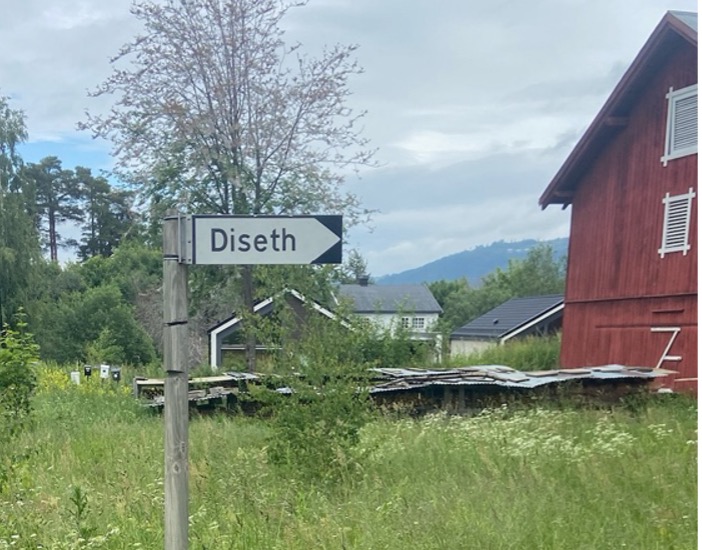
A white, wooden house in east Norway knows me. Its memory called me toward it this summer when my adult child and I arrived in Norway. I didn’t know if it even still stood, but I had to try to find it.
Diseth. A house with its own name.
I heard its name first in 1970 when I was twenty. When my mother’s cousin Mall gave me a name over the phone, I thought Diseth must be the town name so I asked for the house address. She said that the house Diseth was near the town Biri.
I visited then for the first time. I visited again in 1980 and in 1992. Last summer, in 2025, I hoped to see it yet once more.
My first visit
I was traveling with a friend. The day was cold, filled with snow and darkness, just one day after Christmas.
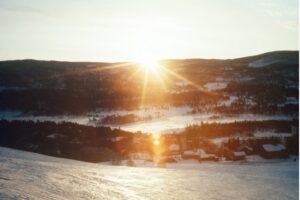
The moment of sunshine, Norway, Christmas, 1970
We were underdressed for a Norwegian winter and poorly equipped. My friend carried a duffle bag instead of a backpack. We set off hitchhiking from the mountain town where our winter college tour had dropped us. It was to be a three-hour ride, but no Norwegians were out driving on this Second Christmas Holiday. Finally one car approached, stopped, picked us up, and dropped us, shivering, at a bus terminal. There was only one bus, so I told the driver, “Near Biri. A house called Diseth, please.”
I don’t remember – did the driver take us all the way to Diseth? Perhaps we got off at a station and called for Mall to pick us up.
My first sight of the driveway was when the headlights picked out the name on a small white sign: “Diseth.” Then I saw the tall aspens flanking the entryway and the house framed between them. This was some rich people’s house, I thought, not a house for relatives of mine.
But there we were, at Diseth’s door. We stepped into a bright Nordic Christmas. Red and blue and white on the tree. Heat-radiating enameled stoves in each room. Cedar and pine scent mingling with the aromas of dinner. Taking our coats and warming our hands, Mall and her sister Ingrid led us into the dining room. We were seated at a holiday feast – cloudberry, lefsa, aquavit, salmon, elk, potatoes with parsley, flatbread, herring in sauces, lingonberry . . . Candles lit the table.
Had I, perhaps, entered heaven. Why would my grandfather have left such a place?
But the house hadn’t been there in 1908 when he, an economic refugee, boarded the boat. Diseth was built some years later by his elder brother, the one who did well once five of his nine siblings cleared out to try their luck in Minnesota.
Sixty-two years after Grandpa left, I was back, the first of my family to return. Mall and Ingrid welcomed me as if I were one of their own.
Ingrid was a teacher married to a comfortable colleague who was also a coach. She understood students. She watched me sympathetically. Mall, the older sister, was a politician and a bureaucrat, a self-assured, cigarette-smoking, slow-to-speak thinker.
They were not Christians according to my Minnesota family’s definition. They were Lutherans, more or less. They lived in Norway and, thus they were, by definition, Lutheran. These were relatives, but they were also worldly. Just the same, they didn’t appear to be miserable or to feel guilty. They were welcoming and loving. Could secular people actually be at peace with themselves? My upbringing had not entertained that possibility.
I was confused and near panic. My friend had discovered her lesbianism and wished me to join her; for my part I was trying to save her since God, I had been trained to believe, did not create anyone “that way” and could, certainly, “fix the problem.” But I cared for her. Was I also lesbian and, thus, offensive to God and my family? In 1970 there was no one to ask about such things; the encyclopedia we consulted said that lesbianism was a “mental illness, thought to be incurable.” The world was not turning out to match the map my loving family had given me.
The sisters, along with Odd Jens, Ingrid’s husband, fed us and questioned us gently. They asked me to play the piano. These were my relatives. This was my family. Had I asked, they may have offered me some balanced wisdom, but I didn’t ask.
I have forgotten much of that visit – lost in a whirl of confusion. I had even forgotten that I came back that summer until I found a sun-lit picture of Mall at the orchard side of the house.
Ten years later
I returned to them in the summer of 1980.
This time, I was more able to notice the space. My journal described it–
Sitting room. Mall walks with her crutch to get breakfast. Mall and Ingrid tell me their dreams. Ingrid: “When we were children we were told that a dream of falling down meant we were growing up.” Mall: “In my dream I had no clothes.” Ingrid: “In mine I was late and I still could not rush.” Mall: “I dreamed often that I was married to our king. I was presented to the people.” A huge grandfather clock swings to my left. There are candles on the black table, the walls are covered with woven reed mats, and a harpsichord stands by the four-level stove. Art hangs on the walls – early morning water with one sailboat and one rowboat and low mountains across on the shore; a girl looking out the sewing room door; a goat-keeper’s mountain hut; a man watching the sunrise over the next mountain. Under these stands a walnut chest.
This time I smelled the roses (along with Mall’s cigarettes) when I stood on the veranda. I told them of my grad school research into the lives of rural women. Mall glanced at Ingrid. “She should meet Klara Schee,” Mall said. Klara, she explained to me, had invented the way to weave the reed mats that covered their walls.
Mall made a phone call.
Klara walked into the sitting room, her eyes sharp and her handshake firm. She wore corduroy knee-length pants, long stockings, and walking shoes. Her jacket was loose. She had short gray straight hair and a small chin.
She said she had come to take me to her farm. We four drove to her farm. There Klara Schee told me that I needed to learn about my spineside – the side of the spinners in my family. At home in Minnesota we had my mother’s mother’s mother’s spinning wheel, so probably her.
I told her that my maternal grandmother’s people had come from Sweden, but I didn’t know where in Sweden. I told her I knew nothing about them. She could probably hear that I also didn’t want to learn; Sweden, I had come to feel through my family, was a place to avoid.
Mall was 59 at that time. Ingrid was 58. Rather young, I now think. Old, I thought then.
Then in the 90s, with children
I returned in August of 1992 with my three children. My step-daughter was 15; my two little ones were three and six.
Mall and Ingrid opened their arms and smiled when we arrived. We were wanted here. I sometimes felt we were unwanted in our Minnesota home.
On that visit, the teen and I drank coffee with the relatives in the sitting room while the little ones ate berries and fruit in the kitchen house in the orchard.
A late summer sun shone.
I was facing single-parenthood and poverty. How would I make it? How would I protect these children? To be a solo parent would be an affront to all my American relatives, to the whole world, I thought.
I hardly heard Mall and Ingrid when they spoke to me of their concern for their home and its land. Since they were without children, they didn’t know who might care for Diseth when they passed on. They looked questioningly at me. Did they wonder, I thought, if I could take care of this place? I was American. I had three children. I was poor.
Maybe, they said, if they gave the fields to a group that would build a home for the elderly and a pre-school for children, maybe then that group would also protect the house and the trees and the orchard. Maybe that could be arranged.
I did not understand then what it was like to be facing the end of the time when one could tend to a place that relied on one. Mall was 80. Ingrid 79.
I moved on, taking my children and my worries with me.
Seeking the way back in 2025
Mall had passed away at 90 and Ingrid was also gone. I couldn’t call them for directions when my adult child Mia and I arrived in Norway this past summer. I couldn’t locate the house on any map. Perhaps it was gone.
I had to try, and I thought I’d recognize it when we drove by on the road.
But when Mia and I drove toward Lillehammer, we found that the road no longer went through Biri. The new expressway was hemmed in by barriers and had no off ramps. We whizzed below the area where Biri must be.
Mia had to be convinced to circle back on the winding old road to search for what was possibly a phantom of my memory. I scanned each driveway. No. No. Rather like that one, but no. Nothing matched my memory.
Mia was ready to turn around again when I decided to step into a grocery store. The man filling the vegetable stand hadn’t heard of Diseth; he directed me to the woman feeding soda bottles into the dispenser.
“Diseth, a big house you say?” She thought. “There’s a kindergarten by a road with that name. Just further down that way. That may be it.”
We drove a little beyond. A old folks home. I remembered with a start what Ingrid and Mall had spoken of the last time I saw them.
Just then, a sign appeared announcing “Diseth Barnehage” (Diseth nursery school) and, next door, a modern residence for elderly folk.
Then, like a crack into the past, the sign for the house appeared by a passageway flanked by trees.
We parked and walked toward the door, the same door. Through the window I saw geraniums blooming on the table. The enameled dining room stove stood quietly, the place settings and cutlery lined the shelves.
“You were so afraid,” the house seemed to say. “You were young then and confused. Now you’re back.”
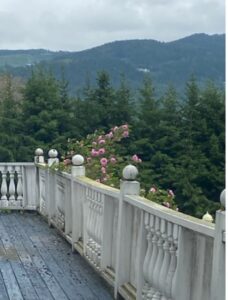
Remembered by the house
In 2025 the house was locked and empty of people. But it was not abandoned. Mia and I walked along the porch that wrapped the house. Spring lilacs were blooming. And old roses hung on the railing. Putting my nose to the blooms, I felt my former selves re-entering me.
When I looked in the window, I saw myself reflected back. I might have been Klara herself – knee-length pants, boots, loose jacket, short gray straight hair, small chin. Klara had been 72 when I met her. I was older than that now.
And only now was I doing what she had told me to. The next week Mia and I would be going to Sweden to find my grandmother’s mother’s home. At last I was seeking my own spineside.
“It took you some decades,” the house said to me, “but you have finally remembered what you were to do.”
Mia and I walked to the front of the house. We looked through the windows of the morning room. Light shone through the blue vases on the window shelves, vases Mall had treasured, that she told me had been made in Biri. In a wicker chair was an embroidered pillow I had leaned against.
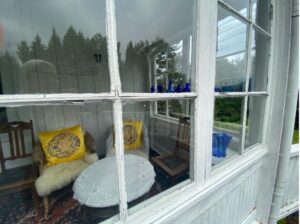
We had been drinking coffee together when the sisters had talked of their concern for the future of the house. And now I knew they had succeeded. The house was still here.
Mia and I looked out over the orchard. The years of my life were folding into me again. My children had thrived in spite of my single-parent status, in spite of my terror.
In preserving this house, Mall and Ingrid had given me back a breath of my youth and extended the protection they had offered my children and me. We stood at the front of the house, looking out over the grassy field lined with fruit trees.
“Welcome back,” the house and the yard seemed to say. “We knew you’d come. We’ve waited for you.”
Leaving Diseth
Could I tell the house my present fear?
How, I asked it, could the earth and its living fabric possibly survive the insanity that the new US administration and the leaders of similarly autocratic governments were unleashing upon it? How could my own children survive? What about immigrants and children of immigrants?
“You’ve always been afraid of something,” the house reminded me. “Walk with fear as your companion.”
My grandpa had never visited Norway after he first left because the Second World War began the year he bought a ticket to come back. His mother died before the war ended and then he didn’t want to come back. Millions died because of that war. The people in this house had also been afraid.
“What’s coming could be worse than that second war,” I whispered.
“Yes, maybe,” the orchard seemed to say. “But we’ll give fruit as long as we can.”
As we turned back to the car, I noticed that the house was becoming shabby. Would it crumble back to earth? Would that, actually, be bad? Did anyone younger than me need to visit this home?
My children had eaten in the tiny orchard kitchen on their visit here. It wasn’t in the orchard anymore, but Mia found it as we walked toward the earthen ramp that still leads to the red barn’s loft. We looked in through the gingham-curtained window. They are here too, my children, held in the memory of this tiny house.
May the children of all current immigrants feel safe enough to visit the lands of their parents, may they be welcomed. May the groves of their homelands be green, the roses still blooming.
May they too allowed to remember themselves.
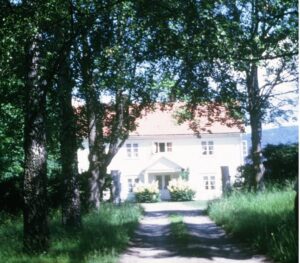
Diseth from a 1970s slide
Beautifully evocative, Ranae!! Thank you for not letting it die just yet.
I”m glad to share this place with you, Nor.
Ah, Ranae, you touch my heart.
Thank you, Rosy!
I love “seeing” these pictures of Diseth after “hearing” your story some time ago. A home and land that came to life and was loved by our family. Grandpa also accomplished much in Minnesota. Thank you, Ranae, for visiting Norway, for imparting heritage, and retelling these powerful stories down.
It’s great to overlap in our research, Jeannie! This was my Wick grandpa, not our Hanson grandpa. Grandpa Hanson’s mother came from near Stavanger. I think you visited there. I would love to see your pictures from then if you have them.
Beautiful. It comforts me to remember that searching is the first step to finding.
I carry your words with me, Noell – “Searching is the first step to finding.”
Beautyfull! I remember our trip to Biri!
Yes, you have shared this place with me.
Thank you, Ranae! It is so evocative and makes me wonder about my ancestors’s homes. And the power houses have for us.
Those ancestors, Dorsey, seem to me to be more near than I had thought. I say this now as you are holding a beloved one in your heart. My love is with you both.
Thank you for sharing these stories. They are so evocative. I can feel and even smell the place.
Thank you for sharing these stories. They’re a precious gift to you family and to all of us.
A touchstone through the generations. And seeing yourself as Klara… I think I know that feeling. Thank you for writing this, Ranae.